
A broken or lost front tooth is one of the most stressful dental emergencies. Unlike a back tooth, where function is the main concern, a missing front tooth affects how you speak, smile, and feel every time you look in the mirror. The good news: with modern implant dentistry, a single front tooth often blends seamlessly with the surrounding teeth.
In this guide, Dr. Anurag Gupta and the team at Grafton Dental Care share a real case recently completed in our Grafton, MA office. Then we walk through why a dental implant is a leading solution for a missing front tooth, why anterior implants are one of the most demanding procedures in dentistry, and how the latest techniques deliver natural-looking results.
A Real Case: Front Tooth Implant at Grafton Dental Care
The case below is a recent example from our Grafton, MA office. Dr. Gupta replaced a failing front tooth with an immediate implant, preserved the gum and bone architecture, and delivered a final crown that blends with the surrounding natural teeth.
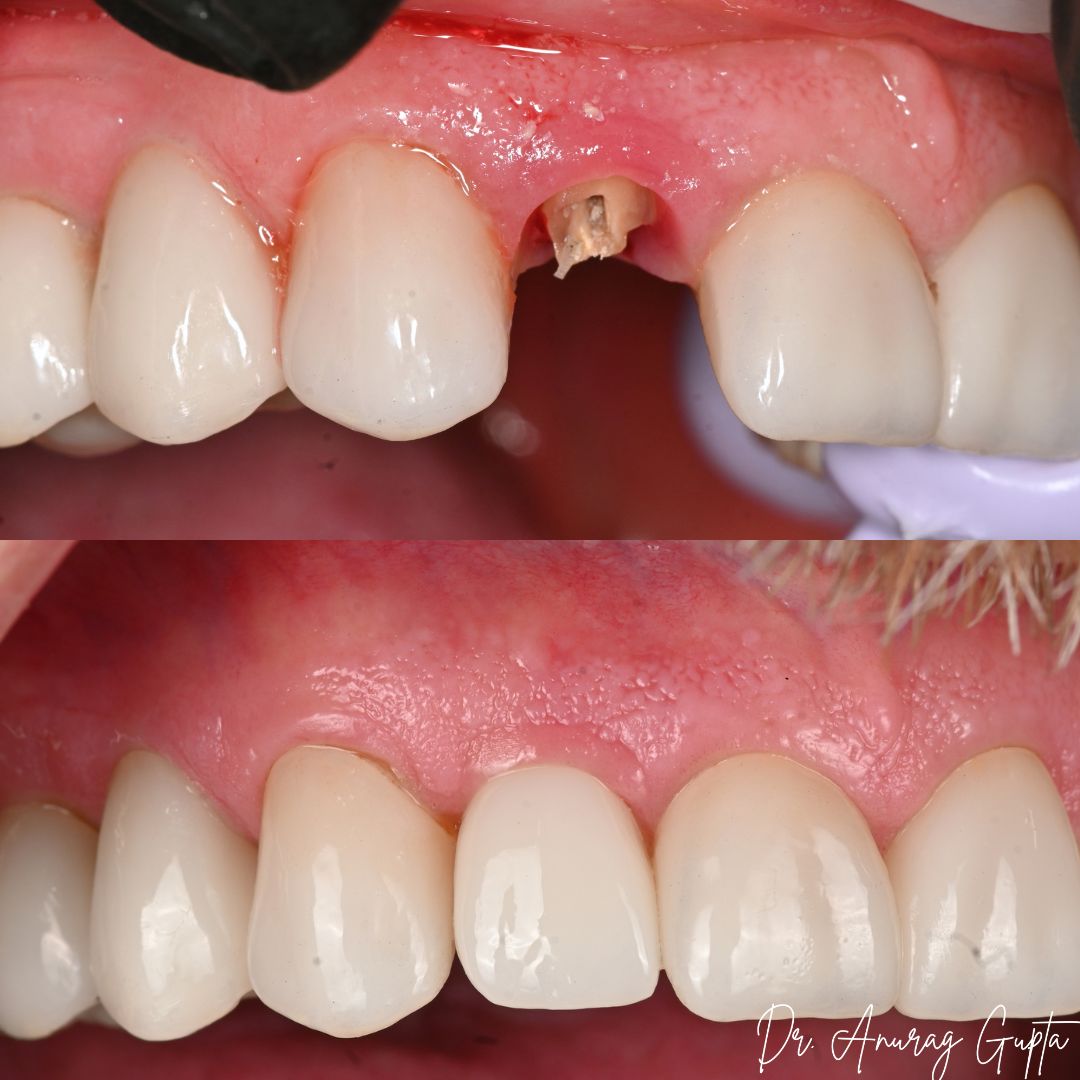
The patient came to our practice with a front tooth fractured below the gumline. A crown or root canal could not predictably save it. Dr. Gupta evaluated the case with 3D CBCT imaging and confirmed the patient was a strong candidate for an immediate implant.
The procedure in five stages
- Atraumatic extraction. Dr. Gupta removed the failing tooth using specialized instruments that preserve the surrounding bone, especially the thin facial bone plate critical to anterior esthetics.
- Immediate implant placement. Dr. Gupta placed the implant in the extraction site at the planned 3D position. He angled it to support the future crown and preserve the natural emergence profile.
- Bone grafting around the implant. Dr. Gupta added grafting material in the small gap between the implant and the existing bone. This maintains the ridge contour during healing.
- Healing and integration. Over the following months, the implant fused with the surrounding bone (osseointegration) while the gum tissue matured around it.
- Final crown. The lab designed a custom porcelain crown to match the size, shape, shade, and translucency of the adjacent teeth. Dr. Gupta attached the crown to the implant, completing the restoration.
The result: a single front tooth that closely resembles the original in look, feel, and function, with the surrounding gum and bone architecture preserved. The patient walked out of our office able to smile again with renewed confidence. Below, we walk through why a dental implant leads as a replacement option for a front tooth, what makes the anterior region demanding, and how techniques like immediate placement deliver these results.
Why Replace a Front Tooth with a Dental Implant?
When you lose a front tooth (whether from trauma, a deep fracture, a failed root canal, or advanced decay), you typically have three replacement options: a removable partial denture, a tooth-supported bridge, or a dental implant. For most healthy adults, an implant is often the preferred option in the front of the mouth.
Four reasons an implant leads as a front tooth replacement
An implant protects the adjacent teeth. A traditional bridge requires Dr. Gupta to grind down the two healthy teeth on either side of the gap so they can support the bridge. With an implant, those neighboring teeth stay untouched.
An implant preserves the bone. The jawbone shrinks when a tooth goes missing (bone resorption). An implant stimulates the surrounding bone the way a natural root does, keeping it healthy. This matters most in the front of the mouth, where bone loss quickly becomes visible as a sunken appearance under the lip.
An implant looks and feels like a natural tooth. A properly placed and restored implant anchors into bone, does not move, does not come out at night, and accepts brushing and flossing like any other tooth.
An implant offers a long-term solution. Bridges typically need replacement every 10 to 15 years. Long-term studies report success rates above 95% at 10 years for well-maintained dental implants, and many remain in function for decades.
What Makes Replacing a Front Tooth So Challenging?
Back-of-the-mouth implants focus on function. Front implants focus almost entirely on esthetics, and esthetics in the anterior is the most demanding work in dentistry. Dr. Gupta plans around three core challenges in every anterior case.
1. Preserving the gum architecture (papillae)
The small triangles of gum tissue between your front teeth are called papillae. They give a smile its natural, scalloped contour. When a tooth is lost, the papillae often shrink and create dark spaces (the dreaded “black triangles”). Preserving the papillae during extraction and implant placement is one of the most delicate steps in anterior implant dentistry.
2. Preserving the underlying bone
The bone supporting the gum tissue forms a thin, delicate scallop in the front of the mouth. When you lose a tooth, this bone (especially the thin facial plate) can collapse within weeks. Once the bone is gone, the gum line drops with it. The implant tooth then looks longer than the neighbors no matter how perfectly Dr. Gupta makes the crown.
3. Matching size, shape, color, and translucency
A natural front tooth has subtle features that are easy to miss but instantly noticeable when they’re wrong: a slightly translucent incisal edge, a warmer color near the gumline, fine surface texture, and a length and width that mirrors the tooth on the opposite side. The final crown has to recreate all of these.
Dr. Gupta solves these three challenges together, often within hours of removing the failed tooth. That’s why anterior single-tooth implants demand careful surgical planning, precise execution, and an experienced restorative team.
The Solution: Immediate Implant Placement
The most predictable way to preserve gum and bone architecture in the front of the mouth is a technique called immediate implant placement. Dr. Gupta extracts the failing tooth and places the implant in the same appointment, before the bone and gum can collapse. For the right case, this approach offers several major advantages.
Why immediate placement works so well
Fewer surgeries. Instead of an extraction, months of healing, then a second surgery to place the implant, everything happens in a single visit.
Better preservation of bone and gum. The implant occupies the space immediately and supports the surrounding tissues. Dr. Gupta typically adds bone grafting material around the implant in the same visit to further stabilize the architecture.
A faster path to the final tooth. In many cases, Dr. Gupta attaches a temporary tooth the same day, so you are never seen in public without a front tooth.
Esthetic predictability. Because the gum and bone stay preserved from the start, the final crown has a much better chance of looking very similar to the natural tooth it replaced.
Not every patient is a candidate for immediate placement. Factors like infection, bone quantity, gum thickness, and bite forces all matter. Dr. Gupta uses 3D cone-beam imaging (CBCT) and digital planning to determine the right approach for each case.
Frequently Asked Questions About Front Tooth Implants
Timeline and procedure
How long does a front tooth implant take from start to finish?
Most anterior implant cases take three to six months from extraction to final crown, depending on bone and gum healing. In many cases, a temporary tooth is provided on the day of the implant placement so the patient is never seen without a front tooth in public.
Is getting a front tooth implant painful?
The procedure is performed under local anesthesia and is generally well-tolerated. Most patients describe the experience as easier than they expected. Post-operative soreness is typically mild and managed with over-the-counter pain relievers for a day or two.
Can a front tooth be extracted and replaced with an implant on the same day?
Often, yes. This is called immediate implant placement, and when the case is appropriately selected — adequate bone, no active infection, healthy gum tissue — it offers the best esthetic outcomes and the fewest surgeries for the patient. The decision is made based on a 3D CBCT scan and clinical exam.
Cost, esthetics, and longevity
How much does a front tooth dental implant cost?
The cost depends on whether bone grafting is needed, whether a temporary tooth is fabricated, and the complexity of the final crown. At Grafton Dental Care, we provide a detailed estimate after the exam and work with most dental insurance plans, many of which cover a portion of implant treatment. Financing options are available.
Will anyone be able to tell I have an implant?
When the case is planned and executed carefully, a single front tooth implant is very difficult to distinguish from a natural tooth — even up close. The crown is custom-shaded and shaped to match the adjacent teeth, and proper soft-tissue management preserves the natural gum contour.
How long will a front tooth implant last?
With good oral hygiene and regular dental visits, long-term studies report success rates above 95% at 10 years for well-placed dental implants, and many remain in function for decades.
Replacing a Front Tooth in Grafton, MA at Grafton Dental Care
Have you fractured a front tooth? Been told a front tooth can’t be saved? Lived with a missing or unsightly front tooth for years? You don’t have to settle for a removable appliance or a bridge that compromises healthy teeth. Dr. Anurag Gupta and our team offer comprehensive anterior implant care, from 3D digital planning to immediate placement to natural-looking final crowns — all under one roof in Grafton, MA.
Call us at 508-318-4477 or schedule a consultation online to find out if a single front tooth implant is right for you.