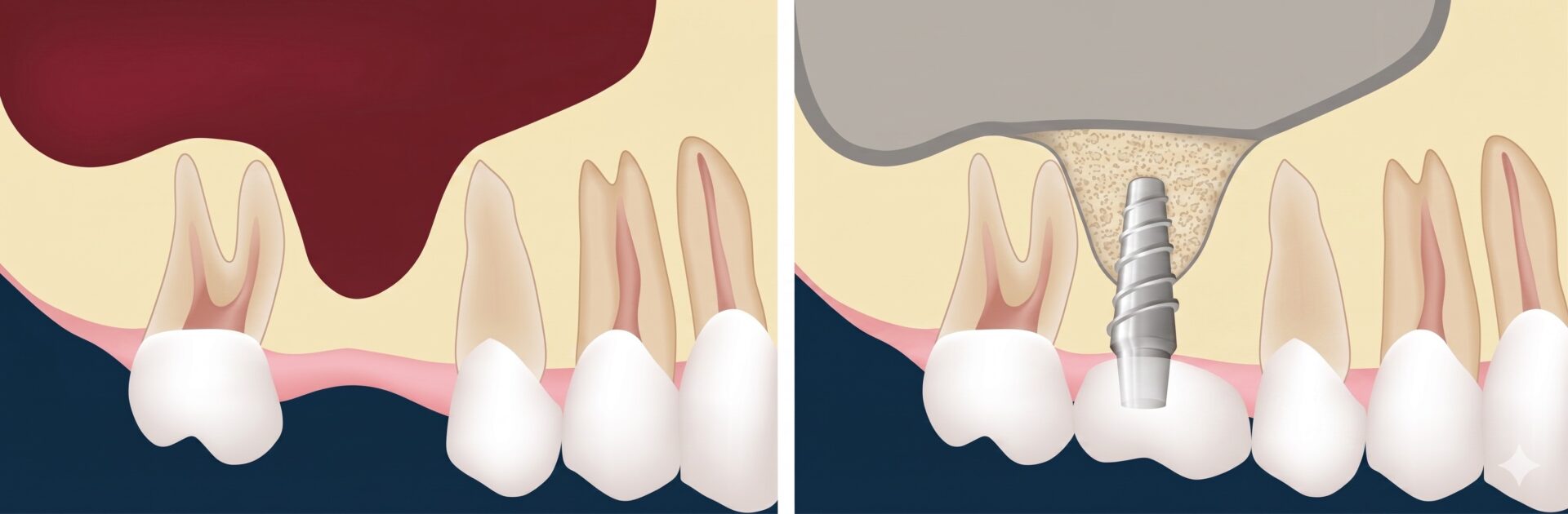
When a patient loses an upper back tooth, the bone in that area often shrinks over time and the maxillary sinus, the air-filled space above the upper jaw, gradually expands downward into the empty space. After several months or years, there may not be enough bone height left to safely place a dental implant. A sinus lift — also called a sinus augmentation — is the procedure used to rebuild that lost bone so a dental implant can be placed and supported for the long term.
This guide explains why a sinus lift may be needed, how it is performed at Grafton Dental Care, what the risks and benefits look like, and what to expect during healing.
Why a Sinus Lift Is Sometimes Needed Before a Dental Implant
The roots of upper back teeth (premolars and molars) sit close to the floor of the maxillary sinus. When one of these teeth is lost, two things tend to happen over time:
- The bone shrinks vertically. Without a tooth root stimulating it, the alveolar bone that once supported the tooth begins to resorb. This loss is most rapid in the first year after extraction.
- The sinus expands downward. The sinus floor naturally pneumatizes — meaning the air space enlarges into the area the tooth root used to occupy.
A dental implant typically needs about 8–10 mm of bone height to be placed safely and to support normal chewing forces. When the remaining bone above the gum and below the sinus is thinner than this, the implant either cannot be placed at all or would project up into the sinus — an outcome that risks infection and implant failure. A sinus lift rebuilds the missing bone so the implant has a healthy, supportive foundation.
How a Sinus Lift Is Performed at Grafton Dental Care
There are two main approaches, and the choice depends on how much bone is already present and how much new bone is needed.
Crestal (internal) approach
When a moderate amount of bone is present — typically 5–8 mm — Dr. Gupta may perform a crestal sinus lift through the same small opening used to place the implant. The sinus membrane is gently elevated from below, a small amount of bone graft is introduced, and the implant is placed in the same visit. This approach involves less surgery and a shorter recovery.
Lateral window approach
When the available bone is thinner (often less than 5 mm) or when a larger lift is needed, a lateral window sinus lift is performed. A small access window is created in the side of the upper jaw bone, the sinus membrane is carefully lifted away from the bone, and bone graft material is placed into the space created beneath the membrane. The window is covered with a thin protective membrane and the gum is sutured closed. Depending on the case, the implant may be placed at the same time or after a healing period of several months.
Both approaches are performed under local anesthesia, often with the option of mild sedation, and both are designed to keep the sinus membrane intact while creating a stable bed of new bone for the implant.
Risks and Considerations
A sinus lift is a well-established procedure with a strong record of success when performed by an experienced clinician. Long-term studies report sinus augmentation success rates above 95% for supporting dental implants. As with any surgical procedure, there are some risks to be aware of:
- Sinus membrane perforation. The Schneiderian membrane lining the sinus is thin and can occasionally tear during elevation. Small perforations are typically repaired during the same visit with a collagen membrane and do not change the long-term outcome.
- Post-operative sinus inflammation or infection. Uncommon, and usually managed with antibiotics and short-term decongestants when needed.
- Graft material migration. Rare when the membrane is intact and standard protocols are followed.
- Delayed healing. More likely in patients who smoke, have uncontrolled diabetes, or have had recent sinus infections.
At Grafton Dental Care, every sinus lift case starts with a 3D cone-beam CT scan so the sinus anatomy, septa, and remaining bone height are fully mapped before treatment. This planning step is what most reliably keeps the procedure predictable.
What to Expect After a Sinus Lift: Healing and Post-Op Instructions
Most patients are surprised at how manageable the recovery is. The discomfort is generally less than that of a tooth extraction, and the majority of patients return to work and normal routines within one to two days.
The first 24–72 hours
- Mild swelling under the cheek or around the eye is normal and usually peaks around day two or three. Cold compresses for the first 24 hours and warm compresses after that help it resolve.
- Some pink-tinged saliva or a small amount of bleeding from the nose is possible for a day or two. This is expected and does not mean anything is wrong.
- Take prescribed medications (typically an antibiotic, an anti-inflammatory, and sometimes a short-term decongestant) exactly as directed.
Sinus precautions — the most important post-op rule
For the first two weeks, the goal is to avoid any pressure change that could disturb the lifted membrane or the bone graft. That means:
- Do not blow your nose. If you need to sneeze, sneeze with your mouth open.
- Avoid using a straw, smoking, or vaping. Suction can dislodge the graft.
- Skip air travel, scuba diving, and vigorous exercise for two weeks.
- Sleep with your head slightly elevated for the first few nights.
- Eat soft, cool foods for the first few days and avoid chewing directly over the surgical site.
Longer-term healing
The bone graft needs time to mature into the patient’s own bone. This process usually takes four to nine months depending on the size of the lift and the type of graft used. During this period the implant either heals (if placed simultaneously) or is placed after the graft has matured. Once integrated, the final crown is attached and the tooth functions like a natural upper molar.
Long-Term Benefits of a Sinus Lift
Restoring bone in the upper back jaw does more than just allow an implant to be placed — it solves several problems at once:
- Stable foundation for the implant. The implant integrates into mature bone and can comfortably handle normal chewing forces.
- Preserved bone for the future. Once an implant is in place and loaded, it stimulates the bone the way a natural root would, slowing further resorption.
- Restored chewing on the side where it has been missing. Many patients have been chewing only on one side for years; a restored back tooth balances the bite again.
- A long-term solution. When properly placed and maintained, dental implants supported by a sinus lift have a strong track record over many years.
Frequently Asked Questions About Sinus Lifts
Is a sinus lift painful?
The procedure itself is done under local anesthesia, so it is not painful during surgery. Afterward most patients describe pressure and mild swelling rather than sharp pain, and over-the-counter or short-term prescription medication usually controls it well.
How long does the procedure take?
A straightforward sinus lift takes about 60 to 90 minutes. Cases where the implant is placed at the same time may take a little longer.
Will I need to be sedated?
Most sinus lifts are completed comfortably with local anesthesia alone. Mild sedation is available for patients who prefer it, and Dr. Gupta will discuss the right option at the consultation.
How long until I can get the implant and the crown?
If the implant is placed at the same time as the sinus lift, the total healing time before the final crown is typically four to six months. If the lift is done first and the implant placed later, the full timeline is usually six to nine months. The longer wait reflects how predictable the long-term result needs to be, not a difficulty in the procedure.
What kind of bone graft material is used?
Sinus lifts can be performed with the patient’s own bone, processed donor bone, bovine bone mineral, or synthetic graft materials — or a combination. All are biocompatible and well studied. Dr. Gupta will recommend the option that fits the specific case.
What happens if a sinus lift is not done when it is needed?
Without enough bone height, an implant cannot be placed safely in the upper back jaw. The alternatives are a dental bridge using the neighboring teeth as supports or leaving the space empty — both of which have trade-offs that a sinus lift with an implant tends to avoid.
Sinus Lifts and Dental Implants in Grafton, MA
If you have been told you may not have enough bone for an upper back implant, or you have been living with a missing upper molar and want to know your options, a consultation is the right next step. Dr. Anurag Gupta and the team at Grafton Dental Care use 3D imaging and modern grafting techniques to plan each sinus lift around the individual patient, with care taken to keep the procedure comfortable and predictable.
Schedule a Sinus Lift Consultation
Grafton Dental Care · 96 Worcester Street, Suite 304, North Grafton, MA 01536 · (508) 318-4477