
By Dr. Anurag Gupta, DMD · Grafton Dental Care, Grafton, MA
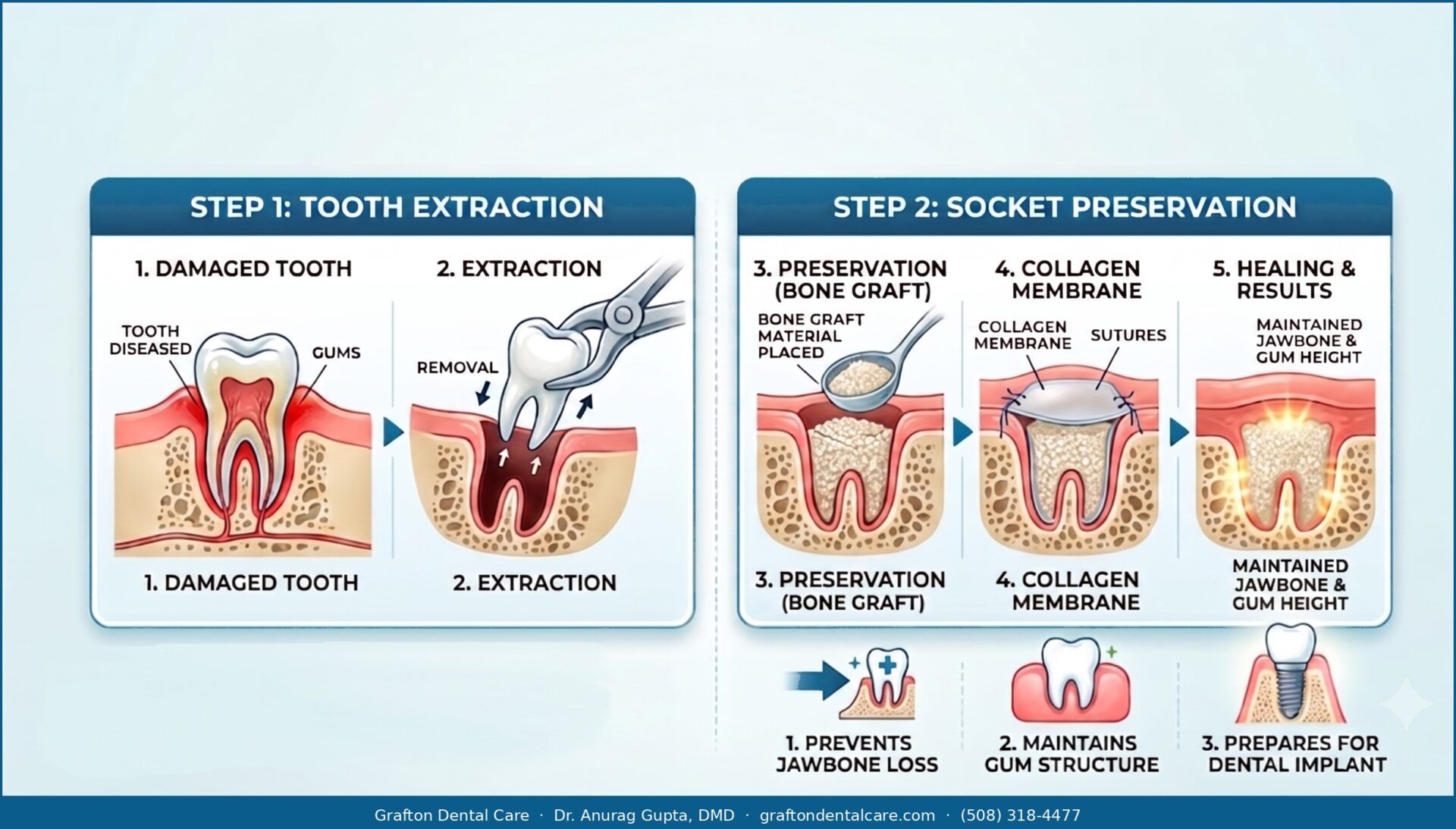
Socket preservation is a bone graft placed at the time of a tooth extraction to stop jawbone shrinkage before it starts. When a tooth is removed, the surrounding bone begins resorbing within weeks. By the end of the first year, the jaw typically loses 25 to 40 percent of its width at that site and a few millimeters of height, with no pain to signal it while the gum heals normally on the surface. For patients planning a dental implant, this matters: an implant needs enough bone to anchor into, and significant shrinkage can mean additional bone rebuilding before placement is even possible.
Socket preservation (also called alveolar ridge preservation) is a bone graft placed at the time of extraction to slow that loss and hold the jaw ridge in the shape needed for a future implant. Below is what the procedure involves, who needs it, and what recovery looks like.
Why Bone Is Lost After a Tooth Extraction
The bone that holds a tooth in place (the alveolar bone) exists to support tooth roots. Its shape, thickness, and density depend on the mechanical stimulation of biting and chewing transmitted through those roots. When the tooth is gone, that stimulation stops, and the bone has no signal to maintain itself. Your body begins to resorb it.
The process follows a predictable pattern:
- First four weeks: The thin wall of bone on the cheek side of the socket (the buccal plate) is especially vulnerable. It can resorb by half a millimeter or more during early healing.
- First three to six months: The majority of bone loss occurs. Width shrinks by 25 to 40 percent; height can decrease by 1 to 2 mm or more, depending on the site.
- Six months to two years: Resorption slows but continues gradually for years if no implant root is placed to stimulate the bone.
Once significant bone loss occurs, rebuilding it requires additional surgical procedures, longer timelines, and more cost. Preserving bone at the time of extraction is simpler and less expensive than rebuilding it after the ridge has collapsed.
What Socket Preservation Involves
Socket preservation is performed at the same appointment as the extraction. After the tooth is removed, the socket is cleaned, then bone graft material is packed into the space to support the surrounding walls while new bone grows in from the sides and base.
A thin collagen membrane or plug is placed over the top, and the gum is sutured closed or left to heal with the membrane visible at the surface (both are normal). The gum closes over the socket within two to four weeks. Over the next three to six months, the graft integrates with your own bone, filling the socket with mature bone ready for implant placement.
What bone graft material is used?
Dr. Gupta selects graft material based on the tooth being extracted, the condition of the surrounding bone, and the implant timeline. The options include:
- Allograft (processed donor bone): The most commonly used material. It is freeze-dried, sterilized, and tested to established safety standards, and it supports excellent new bone formation.
- Xenograft (bovine bone mineral): Derived from bovine sources, processed to remove all organic material. It serves as a scaffold for new bone growth and resorbs slowly, providing long-term ridge support.
- Alloplast (synthetic bone substitute): Biocompatible synthetic materials that also function as a scaffold.
- Autograft (patient’s own bone): Generally reserved for larger grafting procedures; rarely needed for straightforward socket preservation.
All are biocompatible and widely used in implant dentistry. Dr. Gupta will walk you through the recommended option at your consultation.
Does Everyone Who Has a Tooth Extracted Need Socket Preservation?
Not always. Whether socket preservation is recommended depends on the reason for extraction, the condition of the surrounding bone, and whether an implant is planned.
Socket preservation is typically recommended when:
- A dental implant is planned to replace the extracted tooth, and the implant cannot be placed immediately at the time of extraction
- The surrounding bone or gum tissue has been compromised by infection, fracture, or disease that makes immediate implant placement too unpredictable
- The patient wants to preserve the option of an implant in the future, even if the timeline is not yet decided
Socket preservation may not be needed when:
- An implant is placed immediately at the time of extraction (the implant itself occupies and stimulates the socket; graft material is still placed around it to seal the gap)
- The patient has decided not to pursue an implant, and a bridge or partial denture is the planned replacement
- The extraction site is a wisdom tooth with no planned replacement
If there is any chance you will want an implant later, ask about socket preservation at the time of extraction. Ridge collapse is far harder to reverse than it is to prevent.
What Happens If Socket Preservation Is Skipped?
Patients who skip socket preservation and later decide on an implant (or find a bridge or partial denture is not working) often find the ridge has shrunk enough that additional bone rebuilding is needed before placement.
Depending on how much bone was lost, this may involve:
- Localized ridge augmentation: A bone graft placed on the outside of the existing ridge to rebuild its width or height before implant surgery
- Block bone grafting: For larger defects, a block of bone (from the patient or from a donor) is secured with small screws and allowed to integrate before the implant is placed
- Sinus lift: Upper back jaw sites where bone has resorbed below the sinus floor may need a sinus lift to rebuild bone height before an implant can be placed
These procedures add months to the treatment timeline and meaningful cost to the overall plan. Socket preservation eliminates most of this in patients who have it performed at the time of extraction.
Recovery After Socket Preservation
Recovery is similar to a standard extraction. The main difference is that the graft site needs to stay undisturbed while integration begins, so there are a few extra precautions for the first two weeks.
First 24–72 hours:
- Bite gently on gauze for the first 30 to 45 minutes after the appointment to control bleeding
- Take prescribed medications as directed (typically an antibiotic and an anti-inflammatory)
- Apply cold compresses to the cheek on and off the first day
- Eat soft, cool foods and avoid chewing on the extraction side
- No straws, no forceful spitting, no smoking — suction dislodges graft material
First two weeks:
- Avoid probing or touching the socket with your tongue
- Brush gently around the site, avoiding the graft area directly until sutures have dissolved or been removed
- Small white granules at the socket edge are normal: graft material working to the surface, not infection
- The gum tissue typically closes over the socket by the end of the second week
Longer-term healing:
The graft matures into your own bone over three to six months. Dr. Gupta evaluates the site at follow-up appointments, sometimes with a 3D scan, and confirms when the bone is ready for implant surgery.
How Socket Preservation Fits the Implant Plan
Bone quality at the implant site directly affects how predictably the implant integrates and how well it holds up over ten or twenty years. Socket preservation is one of the earliest decisions in that process and one of the least expensive ways to protect the outcome.
At Grafton Dental Care, every patient losing a tooth gets a clear picture of what the extraction means for the bone in that area and what options exist for preserving it. If you want an implant later, even a year or two down the road, the site needs to be ready when you are.
Related reading: Sinus Lift for Dental Implants · Single Tooth Implant Cost: What to Expect at Grafton Dental Care
Frequently Asked Questions
Is socket preservation done at the same appointment as the extraction?
Yes. The graft is placed immediately after the tooth is removed, during the same visit. No separate appointment is needed.
How much does socket preservation cost?
The cost varies depending on the tooth location, the graft material used, and whether a membrane is required. At Grafton Dental Care, it is discussed at the consultation and is quoted as part of the extraction treatment plan before any work is done. Some dental plans cover a portion of bone grafting; Dr. Gupta’s team will check your benefits and walk you through what to expect.
How long do I wait after socket preservation before getting an implant?
Most patients are ready for implant placement three to six months after socket preservation. Dr. Gupta evaluates the site at follow-up appointments and will confirm when the bone is mature enough for surgery.
What if I had a tooth removed years ago and didn’t get socket preservation?
You still have options. A consultation with a 3D scan will show how much bone remains and what, if any, rebuilding is needed before an implant can be placed. Many patients with older extraction sites still have adequate bone; others need a smaller augmentation procedure. The scan gives a definitive answer.
Does socket preservation hurt?
The procedure is performed while the extraction site is already numb. Recovery discomfort is similar to a standard extraction — manageable with over-the-counter anti-inflammatories and ice in most cases.
Can I get a temporary tooth while the socket heals?
In many cases, yes — an Essix retainer with a tooth attached (a temporary removable appliance) can be made to fill the space during the healing period. This option is discussed at the pre-extraction consultation.
Socket Preservation and Dental Implants at Grafton Dental Care
If you have a tooth that needs to be removed — or if you had a tooth extracted in the past and are now thinking about an implant — the right first step is a consultation. Dr. Anurag Gupta uses 3D cone-beam imaging to assess the bone at the site and give you an accurate picture of your options, whether that is socket preservation at the time of extraction or a bone rebuilding plan for a site that has already resorbed.
Schedule a Consultation at Grafton Dental Care
Grafton Dental Care · 96 Worcester Street, Suite 304, North Grafton, MA 01536 · (508) 318-4477