By Dr. Anurag Gupta, DMD · Grafton Dental Care, Grafton, MA
Pterygoid implants anchor in the pterygoid process, a dense section of bone at the back of the skull base. Most patients first hear the term during an upper arch consultation, when a 3D scan shows the posterior jaw lacks enough bone for standard implants. For those patients, pterygoid implants make full-arch reconstruction possible without additional bone grafting.
What Makes Pterygoid Implants Different
A standard dental implant goes vertically into the alveolar bone, the ridge that held the tooth roots. Pterygoid implants take a different path. They angle backward at 45 to 55 degrees, pass through the tuberosity of the upper jaw, and anchor in the pterygoid process of the sphenoid bone, well behind and above where a back molar used to sit.
The pterygoid process is cortical bone: dense and hard, unlike the cancellous spongy bone that makes up most of the posterior upper jaw. It is also largely unaffected by the bone loss and sinus expansion that follow the loss of upper back teeth. Even in patients who have been edentulous for years, the pterygoid process retains enough volume to hold a long implant securely.
Why Pterygoid Implants Are Used
Bone Loss in the Posterior Upper Jaw
The upper back jaw loses bone faster than almost any other site after tooth loss. The bone that supported the upper molars is thin to begin with, and once the teeth are gone, it resorbs fast. Within a few years, many patients have less than 5 millimeters of bone height remaining in the posterior maxilla, well below the 10 to 12 millimeters a standard implant needs.
A sinus lift can rebuild that bone, but it adds four to nine months to the timeline and a separate surgical procedure with its own recovery. Pterygoid implants bypass the problem by anchoring in bone that was never part of the tooth-bearing ridge.
Maxillary Sinus Expansion
After upper molars and premolars are lost, the maxillary sinuses often expand downward into the space previously occupied by tooth roots, a process called pneumatization. This shrinks the bone available for posterior implants. The more pneumatized the sinuses, the less room remains for back implants and the more bone grafting it takes to create it.
Pterygoid implants sit posterior to the sinus. No lift or augmentation needed. In patients with significantly expanded sinuses, this is often the most predictable path to restoring the back of the upper arch.
Immediate Loading
The dense cortical bone where pterygoid implants anchor gives them strong primary stability at placement. Primary stability determines whether an implant can support a temporary prosthesis the same day as surgery. In most full-arch cases at Grafton Dental Care, pterygoid implants supply the stability needed for same-day teeth. Patients leave with a complete, fixed arch the day of surgery rather than waiting months for bone to integrate before teeth go in.
Same-day loading requires precise planning, the right implant positions, and sufficient torque at placement. Dr. Gupta reviews each case with a 3D cone-beam scan before recommending immediate loading to confirm the bone will support it.
How Pterygoid Implants Fit Into Full-Arch Treatment
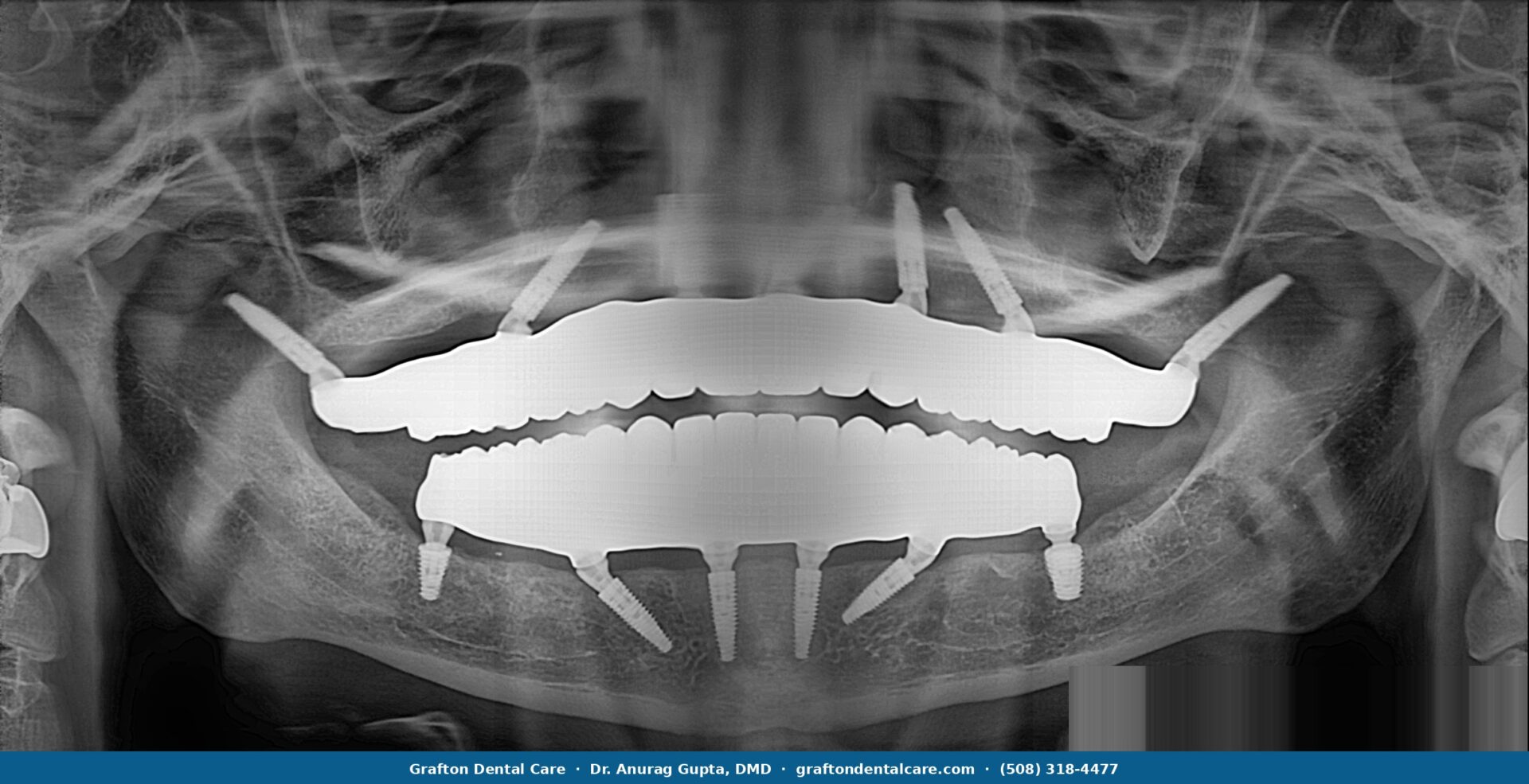
Pterygoid implants work as part of an upper All-on-X case, not as standalone replacements for individual teeth. In a typical upper arch reconstruction, two pterygoid implants anchor the far posterior on each side, while two to four additional implants in the anterior and mid-arch provide the remaining support. The full-arch prosthesis spans all of them.
On a panoramic X-ray the configuration is easy to spot: two long implants angled backward at the rear of the upper arch, with the anterior implants positioned more vertically. The image above shows this in a completed case.
Not every upper arch case calls for pterygoid implants. Patients with adequate posterior bone may do well with a standard All-on-4 or All-on-6. The decision comes down to what the 3D scan shows about bone volume and density at the planned sites.
Cost Considerations
Pterygoid implants demand more surgical skill and planning than standard implants. The placement angle is precise, the posterior maxillary anatomy is complex, and the procedure requires experience with full-arch cases. Pterygoid implants add to the cost of an upper All-on-X compared with cases that use only standard anterior implants.
The cost difference reflects the implants themselves, the additional surgical time, and the 3D planning the placement requires. Dr. Gupta reviews the full treatment plan and costs at the consultation before you commit to anything. For patients who would otherwise need a sinus lift first, pterygoid implants often cost less in total: one surgery, one recovery, and teeth the same day instead of a staged approach over nine to twelve months.
What to Expect at the Consultation
If you are missing multiple upper teeth or wearing an upper denture, the first step is a cone-beam CT scan. The scan gives Dr. Gupta a three-dimensional view of the bone at every potential implant site: height, width, density, and the position of the sinuses. From that data, he determines whether standard implants, pterygoid implants, or a combination gives the most predictable result.
Candidates for pterygoid implants are usually patients who have been told they lack the bone for implants or that they need a sinus lift first. A 3D scan often shows that pterygoid implants make full-arch reconstruction possible in a single procedure.
Related reading: Sinus Lift for Dental Implants: Why It’s Needed and What to Expect · How Much Does a Zirconia Arch Cost? What to Expect at Grafton Dental Care
Frequently Asked Questions
Are pterygoid implants safe?
Yes. Pterygoid implants have decades of clinical data behind them. Placement requires precision and familiarity with full-arch cases, but in experienced hands the procedure is reliable and the outcomes are predictable. Dr. Gupta plans each case from a 3D scan to confirm the implant trajectory and avoid nearby structures.
Do pterygoid implants hurt more than regular implants?
Dr. Gupta performs the surgery under local anesthesia, and sedation is an option for patients who prefer it. Recovery runs similar to other full-arch procedures: mild to moderate discomfort for a few days, manageable with prescribed medications. Most patients find recovery more manageable than they expected given the scope of the surgery.
Can pterygoid implants support same-day teeth?
In most cases, yes. The cortical bone where they anchor provides the primary stability that makes immediate loading possible. Dr. Gupta confirms candidacy at the consultation based on the 3D scan and torque values at placement.
What if I was told I need a sinus lift before getting implants?
Get a second opinion with a 3D scan. Many patients who were told they needed a sinus lift are candidates for pterygoid implants instead, which means full-arch reconstruction in one surgery rather than a staged approach over nine to twelve months. The scan gives a definitive answer about which option fits your anatomy.
How long do pterygoid implants last?
Long-term studies show survival rates above 95 percent at ten years, comparable to standard implants. They need consistent home care and regular professional maintenance. The dense bone where they anchor tends to be stable over time, which is why the long-term numbers hold up.
Pterygoid Implants at Grafton Dental Care
If you have been told you lack the bone for upper implants, or if you want to understand your options for replacing missing upper teeth, start with a consultation and 3D scan. Dr. Anurag Gupta has placed pterygoid implants as part of full-arch upper reconstructions and can show you exactly what your scan reveals and what treatment would involve.
Schedule a Consultation at Grafton Dental Care
Grafton Dental Care · 96 Worcester Street, Suite 304, North Grafton, MA 01536 · (508) 318-4477